
Hejduk Lamp Collection
Separation suggests the momentum of passage.
As gaps form, the back-and-forth movement gains its medium.
Dimensions
Medium: 8.75 in. L x 5.25 in. W x 9.5 in. H
Large: 9.75 in. L x 6 in. W x 9.75 in. H
Materials
PLA Matte
PLA Wood
PLA Translucent

Fabrication

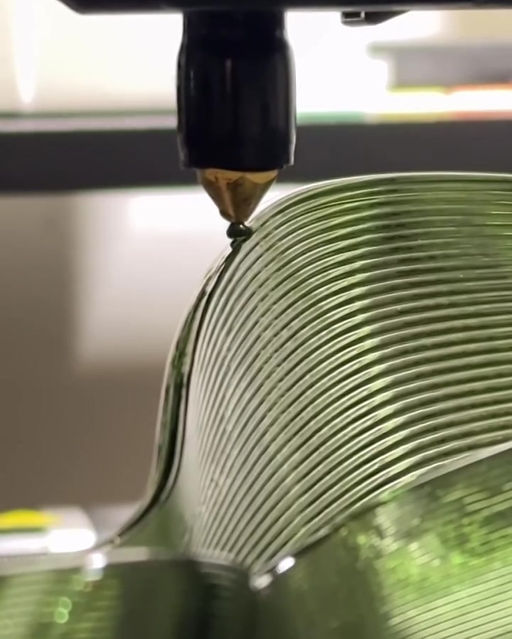
Its fabrication also demonstrates the concept of duality. The flowing shape of lampshade is achieved through non-planar 3D printing: by programming G-code directly, we choreograph the printhead’s motion and extrusion rhythm in three-dimensional space, solidifying the act of traversal into a fluid geometry.

Design
_edited.jpg)


The Hejduk Lamp draws inspiration from architect John Hejduk’s exploration of duality in Wall House II: separation and passage, isolation and connection, the momentary and the eternal. We translate this architectural language into tactile paths of light and shadow—grounding the form in the gravitas of classical columnar textures while introducing parametric, organic curves. The lamp becomes a convergence of time, space, and illumination.

The supporting component, by contrast, is printed with traditional FDM to ensure structural clarity and precise detailing. Their juxtaposition creates another layer of “separation and connection” embedded within the making of the object.
Modularity


This pairing of forms also opens up possibilities for color and texture expression. The Hejduk series currently offers 8 palettes whose contrasting colored geometry can establish a calibrated balance between harmony and tension—allowing the lamp to quietly integrate into a space or stand forward as a visual focal point. Ongoing palette development and customizable options also enable the lamp to adapt to varied spatial contexts.

Regarding the lamp’s composition, modularity brings the idea of duality into everyday use. The shade, frame, and circuitry interlock through fully 3D-printed components, making assembly, repair, and recomposition intuitive. Users can replace individual parts to extend the lamp’s lifespan, refresh its color language, or adjust its character. This replaceability brings duality into user experience— it allows components to remain autonomous while forming new relationships through reconfiguration.

Replaced elements will be collected for centralized recycling—sorted, processed, and reintegrated into new material batches—creating a closed-loop system in which each iteration contributes to the lamp’s continued evolution rather than becoming waste.


